Shaker Style Kitchens: Why the Look Endures and How to Get It Right
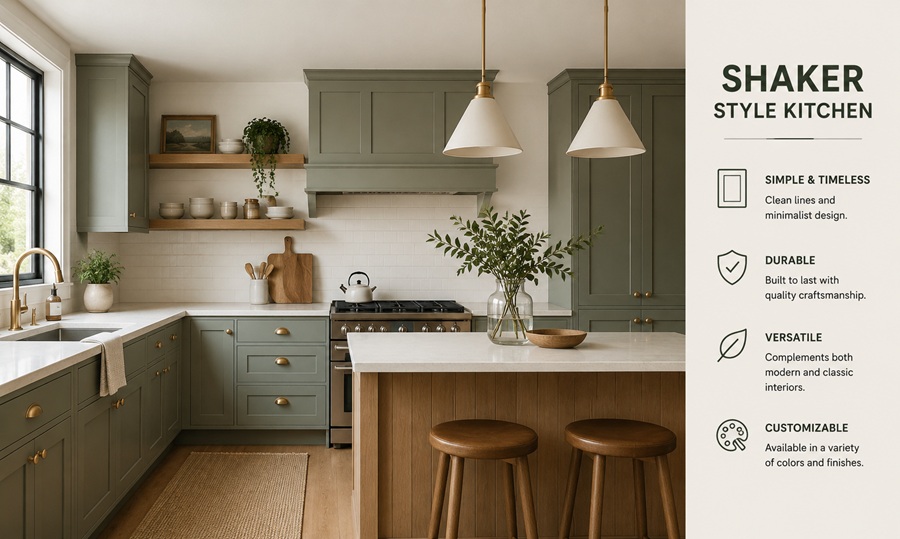
Ask a kitchen designer which cabinet style they’d choose if they could only pick one for the rest of their career, and a surprising number land on the same answer: shaker. It’s been a top-selling cabinet door style for well over a decade now, largely because it manages to look at home in a farmhouse, a mid-century remodel, and a sleek modern build all at once.
| Quick Answer
A shaker style kitchen features simple five-piece cabinet doors with a recessed center panel and flat, unadorned frame, drawing from Shaker furniture tradition. It pairs well with almost any color palette and hardware style, typically costing 10 to 20 percent less than more ornate raised-panel cabinetry. |
What Actually Defines Shaker Style
The shaker cabinet door is a five-piece construction: four flat frame pieces surrounding a recessed center panel. There’s no ornate carving, no raised detail, no curved edges — just clean, flat lines that trace back to 18th and 19th century Shaker furniture makers, who valued simplicity and function above decoration.
The Five-Piece Door Explained
- Two vertical stiles forming the left and right frame edges
- Two horizontal rails forming the top and bottom frame edges
- One recessed center panel, typically flat rather than raised
- A visible reveal where the frame meets the panel, creating the signature shadow line
Why It Photographs and Ages So Well
The flat panel and clean lines of shaker cabinetry don’t go out of style the way more decorative profiles tend to, since there’s little ornamentation to read as dated a decade later. That same simplicity also means shaker cabinets work with an unusually wide range of hardware, countertop, and wall color choices without ever looking mismatched.
Color and Finish Trends
| Color Direction | Mood | Popular Pairing |
|---|---|---|
| Classic white or off-white | Bright, timeless | Brass or nickel hardware, marble-look counters |
| Warm wood tones (natural oak) | Organic, warm modern | Black hardware, stone counters |
| Sage or muted green | Soft, transitional | Unlacquered brass, butcher block |
| Navy or charcoal | Bold, contemporary | Brushed gold hardware, light counters |
| Two-tone (upper/lower contrast) | Layered, custom feel | Mixed metal hardware finishes |
Material Options for Shaker Cabinets
- Solid wood: most durable and refinishable, highest cost tier
- Wood veneer over MDF core: strong stability with a lower price point than solid wood
- Painted MDF: smooth, consistent finish, common in budget to mid-range lines
- Thermofoil: most affordable, but least durable around heat and moisture over time
| Note: Painted MDF shaker doors are prone to chipping at corners if bumped repeatedly. Solid wood or veneer options hold paint better in high-traffic kitchens with young kids or frequent cooking activity. |
Hardware Pairings That Work
- Simple bar pulls in brass or matte black for a clean, contemporary shaker look
- Round knobs for a more traditional or farmhouse-leaning shaker kitchen
- Cup pulls on drawers paired with knobs on doors for a mixed traditional approach
- Minimal or no hardware, using integrated finger pulls, for the most streamlined modern look
Typical Cost Compared to Other Cabinet Styles
| Cabinet Style | Relative Cost | Complexity of Door Construction |
|---|---|---|
| Shaker | Baseline | Simple, five-piece flat panel |
| Raised panel/traditional | 10–25% more | More detailed molding and profile |
| Slab/flat front | Similar to shaker | Simplest, single flat piece |
| Beadboard | 10–20% more | Added detail on the panel surface |
Planning a Shaker Kitchen Remodel
- Decide on cabinet material based on budget and household durability needs
- Choose a color direction before selecting countertops and backsplash
- Select hardware style and finish, testing samples against your actual cabinet color
- Get quotes specifying door material separately from box construction quality
- Confirm lead times, since custom shaker cabinetry can take 6 to 10 weeks to arrive
Frequently Asked Questions
Why are shaker cabinets so popular?
Their simple, flat-panel design pairs well with nearly any color, hardware, and countertop choice, and it doesn’t carry the dated look that more ornate cabinet profiles can develop over time.
Are shaker cabinets more expensive than other styles?
Generally no — their simple construction typically costs the same as or slightly less than more detailed styles like raised panel or beadboard cabinetry.
What paint colors work best for shaker kitchens?
Classic white, warm wood tones, sage green, and deep navy are among the most popular choices, largely because the style’s clean lines complement a wide range of palettes.
Is MDF or solid wood better for shaker cabinets?
Solid wood offers better long-term durability and refinishing potential, while painted MDF provides a smooth, consistent look at a lower price point but chips more easily over time.
How long does it take to install new shaker cabinets?
Custom orders often take 6 to 10 weeks to arrive, with installation itself typically completed within a few days to a week depending on kitchen size.
The Lasting Appeal
Shaker style kitchens have stayed near the top of design trend lists for so long because there’s very little about the style that can go out of fashion — it’s defined by restraint rather than a specific decorative detail. Choose your material tier based on budget and household wear, pick a color that suits your space, and a shaker kitchen tends to remain a safe, adaptable choice for years to come.